Commercial vs. Residential HVAC: Key Differences Explained
HVAC is HVAC, right? Both commercial and residential systems heat and cool spaces using refrigerant cycles, ductwork, and controls. But the similarities largely end there. Commercial HVAC involves dramatically different equipment configurations, far more complex controls, strict code requirements, and higher-stakes consequences when systems fail.
Whether you are a homeowner curious about commercial buildings, a technician considering specialization, or a business owner managing a commercial property, understanding the differences is valuable.
Scale and Capacity
The most obvious difference between commercial and residential HVAC is scale.
Residential systems typically range from 1.5 to 5 tons (18,000–60,000 BTU/hr) of cooling capacity. A large custom home might use two or three systems, each within this range.
Commercial systems span an enormous range — from 5-ton packaged rooftop units serving small retail spaces to 500-ton or larger chillers serving large office towers or manufacturing facilities. A single floor of an office building might require more cooling capacity than a hundred homes.
This scale difference drives everything else: larger equipment, more complex piping and ductwork, more sophisticated controls, and more specialized technicians.
Equipment Types
Residential Equipment
Residential systems are dominated by:
- Split systems: Outdoor condenser/compressor + indoor air handler or furnace coil, connected by refrigerant lines
- Package units: All-in-one units (compressor, condenser, evaporator, furnace) in a single cabinet, typically on a rooftop or slab
- Ductless mini-splits: Outdoor unit with one or more indoor air handlers, no ductwork
Controls are typically a single thermostat or a simple zone control system.
Commercial Equipment
Commercial HVAC uses a much broader range of equipment:
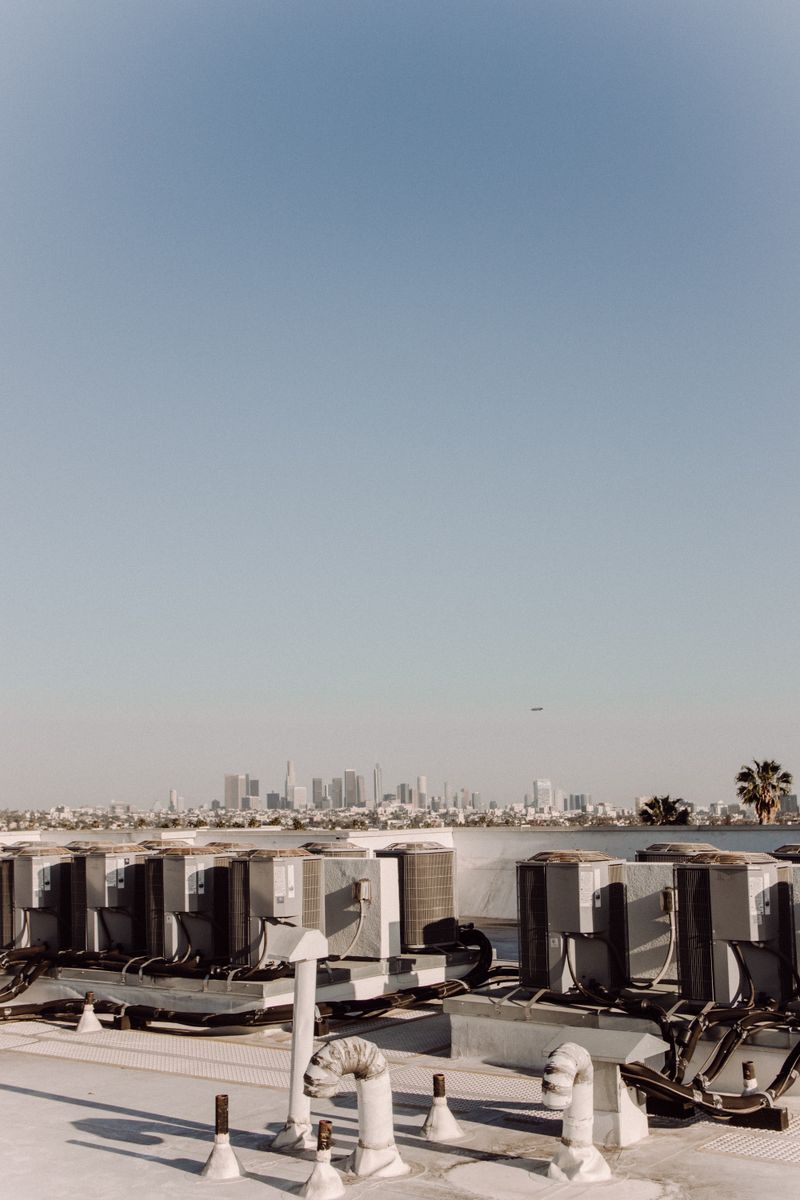
Packaged Rooftop Units (RTUs): The dominant system type for commercial buildings under 30,000 sq ft. All equipment sits in a single cabinet on the roof, with ductwork running down into the building. Rooftop units range from 3 tons to 100+ tons.
Chillers and Fan Coil Units: For large buildings, a central water chiller cools water in a mechanical room, then pumps the chilled water to fan coil units throughout the building. Chillers can be air-cooled or water-cooled; water-cooled chillers are paired with cooling towers that reject heat to the atmosphere. This system allows very precise temperature control in large buildings.
Variable Refrigerant Flow (VRF) Systems: Large-scale versions of mini-split technology, with one or more large outdoor units connected to dozens of indoor units throughout a building. VRF systems provide excellent zone control and efficiency in multi-story buildings where central ductwork would be impractical.
Air Handling Units (AHUs): Large commercial air handlers that condition and distribute air for entire building sections. They may include heating coils (hot water or steam), cooling coils (chilled water), humidification, and elaborate filtration.
Building Automation Systems (BAS): Commercial buildings use computerized building automation systems that integrate HVAC, lighting, security, and other building systems into a unified control platform. A BAS can be programmed with complex schedules, demand response strategies, and fault detection algorithms — far beyond what residential thermostats provide.
Ventilation Requirements
This is perhaps the most significant functional difference between commercial and residential HVAC.
Residential Ventilation
Residential HVAC primarily recirculates indoor air through the system. Ventilation — bringing in fresh outdoor air — happens through natural infiltration (air leaks around windows, doors, and penetrations) and through opening windows and doors. Some residential systems include energy recovery ventilators (ERVs) that bring in controlled amounts of fresh air, but this is optional.
Commercial Ventilation
Commercial buildings have mandatory ventilation requirements. ASHRAE Standard 62.1 specifies the minimum outdoor air that must be delivered to occupied commercial spaces — typically 5–20 cubic feet per minute per person depending on the space type, plus area-based minimums.
For a 200-person office building, this might require 2,000–4,000 CFM of outdoor air to be conditioned and distributed continuously. This outdoor air must be heated in winter and cooled in summer — a significant energy cost that residential systems do not have.
Ventilation systems in commercial buildings include:
- Economizer cycles: When outdoor air is cool enough, the system increases outdoor air intake to provide “free cooling,” reducing compressor operation.
- Demand-controlled ventilation (DCV): CO₂ sensors in occupied spaces signal the HVAC system to increase outdoor air when occupancy is high and reduce it when spaces are empty — reducing energy waste.
- Energy recovery ventilators (ERVs) and heat wheels: Recover heat or cooling energy from exhaust air and transfer it to incoming outdoor air, reducing the energy penalty of ventilation.
Codes and Regulations
Residential Codes
Residential HVAC is governed by International Mechanical Code (IMC) and International Energy Conservation Code (IECC) requirements adopted by local jurisdictions. Permits are required for HVAC installation in most areas. Inspections verify basic code compliance.
Commercial Codes
Commercial HVAC involves significantly more complex regulatory requirements:
- ASHRAE Standard 62.1 (ventilation)
- ASHRAE Standard 90.1 (energy efficiency)
- International Mechanical Code (installation)
- Local fire codes (fire and smoke dampers, equipment room clearances)
- Commissioning requirements (some jurisdictions require formal commissioning documentation for new commercial systems)
- EPA regulations on refrigerant handling, leak inspection frequencies, and retrofit requirements for large refrigerant circuits
Commercial projects typically require licensed mechanical engineers to design the systems, licensed contractors to install them, and third-party commissioning to verify performance.
Refrigerant Handling
Both commercial and residential technicians must hold EPA Section 608 certification to handle refrigerants. However, the certification has different tiers:
- Type I: Small appliances (under 5 lb charge)
- Type II: High-pressure equipment — includes most residential split systems
- Type III: Low-pressure equipment — commercial chillers using R-11 and similar
- Universal: Certifies for all types
Commercial refrigerant management can also involve leak-repair, inspection and recordkeeping requirements. Applicability depends on the appliance, refrigerant, charge and current rule. For example, EPA’s 2026 HFC leak-repair fact sheet addresses certain appliances containing 15 pounds or more of covered refrigerants. Owners and technicians should verify the current rule for the exact equipment instead of relying on a generic charge threshold.
Maintenance Complexity
Residential Maintenance
Residential maintenance usually involves fewer assets and responsibility handoffs. The applicable tasks still depend on the exact equipment, operating conditions and manufacturer instructions. Homeowners can use the residential HVAC maintenance checklist to separate safe observations from professional service.
Commercial Maintenance
Commercial maintenance must coordinate many asset types, service areas, operating schedules, access requirements and authorized parties. A useful plan starts with a uniquely identified equipment inventory, then maps each asset to the exact task and frequency source, responsible party, completion evidence and deficiency follow-up.
Use our commercial HVAC maintenance checklist and PM worksheet to build that record for rooftop units, air handlers, chillers, boilers, pumps, controls, terminal boxes and cooling towers. There is no universal monthly, quarterly or annual interval for every property: adopted requirements, current OEM instructions, warranties, operating conditions and documented findings control the schedule.
Career Path Implications for Technicians
For HVAC technicians, the commercial specialization path offers:
Higher pay: Commercial technicians generally earn 20–40% more than residential technicians at the same experience level.
More technical complexity: Building automation systems, chiller operation, and VRF commissioning require substantial additional training.
Different schedule: Commercial work often happens in unoccupied buildings (nights and weekends) to minimize disruption.
Specialization options: Chiller technicians, BAS technicians, and commissioning specialists command the highest compensation in the commercial sector.
For residential technicians looking to expand into commercial work, ASHRAE training programs, manufacturer-specific training (Carrier Commercial, Trane Commercial), and NATE commercial certification are typical stepping stones.
Regardless of specialization, understanding the full spectrum from residential to commercial HVAC provides a richer perspective on how buildings of all sizes are conditioned — and why the industry’s fundamental importance to health, comfort, and productivity never diminishes.

ThermalTechPro Editorial Team
Independent trade-focused editorial team