Furnace short cycling: find the stopping point
Quick answer
Furnace short cycling means repeated starts and stops that do not complete the expected heat call. Do not diagnose it from a universal minute limit. Record whether the thermostat is still calling, which sequence stage stops, whether the burners or entire furnace shut down, and what the blower does next. Homeowners can verify normal thermostat settings, owner-access filter condition, clear grilles, and visible exterior vent conditions; gas, combustion, electrical, venting, safety-control, and cabinet-open diagnosis belongs to a qualified HVAC technician.
Common questions
- How can I tell if my furnace is short cycling?
- Look for repeated starts and stops before the thermostat is satisfied or the expected heat call is complete. There is no universal number of minutes that defines short cycling for every furnace. Record the thermostat call, the stage where operation stops, and whether the blower or burners keep running.
- Why does my furnace keep shutting off after a few minutes?
- If the thermostat still calls for heat while the burners stop and the blower continues, an airflow or high-limit branch is possible. If the thermostat call ends, investigate controls, sensor location, zoning, load, and sizing instead. The exact sequence and model fault history are needed for diagnosis.
- Can a furnace short cycle without an error code?
- Yes. A code may be stored rather than displayed, may clear when power is interrupted, or the thermostat call may be ending normally from the control's perspective. No visible code does not rule out a fault. Preserve the timeline and let a technician retrieve model-specific fault history.
- Does short cycling mean the heat exchanger is cracked?
- No. Short cycling alone cannot diagnose a cracked heat exchanger. Airflow, controls, ignition, flame proof, venting, sizing, and other conditions can create repeated shutdowns. A qualified technician must inspect and test the furnace using the exact manufacturer procedure.
Source note: Reviewed October 2026 against current Trane and Carrier furnace short-cycling guidance, Goodman/Amana/Daikin model-family service literature, and U.S. Consumer Product Safety Commission carbon-monoxide and home-heating guidance. Sequence, fault codes, timing, temperature rise, filter requirements, venting, and test procedures are model-specific; the current manual for the complete furnace model controls.
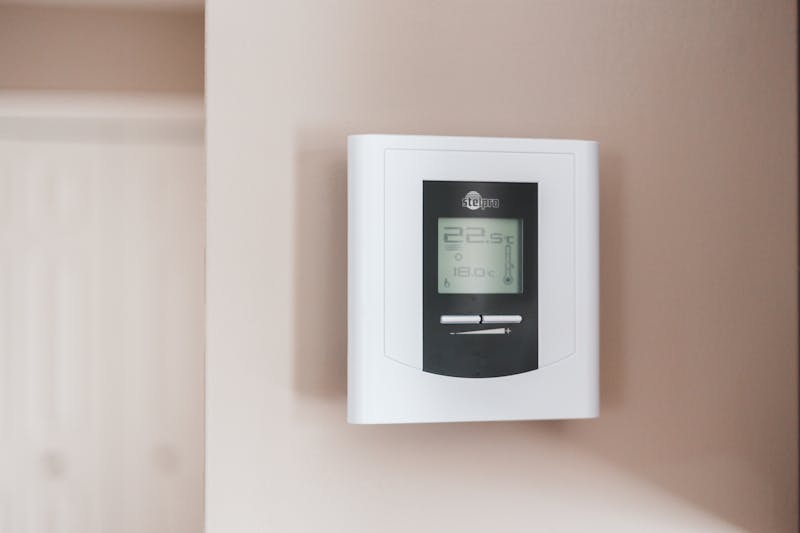
A furnace that keeps shutting off and restarting is giving you a timing clue, not a complete diagnosis. Short cycling means repeated starts that do not complete the expected heat call or reach the thermostat target.
Do not apply one universal cycle length. Weather, load, staging, thermostat logic, zoning, and capacity affect runtime. Ask: Which command or safety ends the cycle, and what was still operating?
Check the emergency boundary first
Leave the home and call 911 or the gas utility from outside if a carbon-monoxide alarm sounds, anyone has possible CO symptoms, you smell gas, or you see smoke, soot, or flame outside its normal enclosed location. Do not operate switches or search for the source.
Carbon monoxide is colorless and odorless. Use the carbon-monoxide and HVAC safety guide for alarm, symptom, and evacuation details.
Short cycling by itself does not prove a cracked heat exchanger. Do not open the combustion compartment, defeat a door switch, bypass a safety, change gas pressure, alter venting, or keep resetting the furnace to test that theory.
Furnace short-cycling sequence and timing table
A common gas-furnace sequence moves from a thermostat call to inducer operation, draft proof, ignition, flame proof, blower operation, and steady heating. Exact order, delays, and fault response come from the complete model’s manual. Observe only from outside the assembled cabinet and through a factory viewing port, if provided.
| Sequence stage | What you observe | Diagnostic branch, not a verdict | Safe next step |
|---|---|---|---|
| Thermostat call | The heat indicator or call disappears before the room reaches its target | Schedule, sensor location, thermostat power or setup, zone logic, or rapid satisfaction near the thermostat | Record mode, setpoint, room temperature, schedule, active zones, and whether the call vanished before equipment stopped |
| Inducer and venting | The inducer starts, but ignition does not begin; the attempt may repeat | Draft proof, intake, exhaust, condensate, inducer, wiring, or control logic may have stopped progress | Note visible exterior intake/exhaust conditions from a safe location and preserve the exact code; use the pressure-switch diagnostic guide for this branch |
| Ignition | The igniter operates or a spark is heard, but stable burner flame does not appear | Ignition source, fuel delivery, gas valve command, burner, control, or a safety may be involved | Do not relight, adjust, or open gas equipment; record the exact sequence and arrange service |
| Flame proof | Burners light and then shut off shortly afterward, often followed by another attempt | The control may not have received acceptable flame proof, but the sensor alone is not proven faulty | Follow the flame-sensor symptom guide and leave the sensing circuit, burner, grounding, and gas checks to a technician |
| Blower onset | Burners operate, but the circulating blower does not start as the model expects | Blower power, motor, wheel, control, setup, wiring, or a limit response may be involved | Stop the heat call and schedule service; do not wait for repeated overheating events |
| Airflow and high-limit behavior | Heat runs for several minutes, burners stop while the blower continues, and heat later retries | Restricted airflow, blower performance, duct or zone conditions, temperature rise, setup, or a safety event may be involved | Check only the specified owner-access filter and uncovered grilles; if the exact manual confirms a limit fault, use the furnace limit-switch diagnostic for the safe handoff |
| Recent sizing, duct, zone, or filter change | The thermostat is satisfied quickly, or cycling began after installation or a system change | Equipment capacity, thermostat location, zoning minimums, duct capacity, blower setup, or filter resistance may be mismatched | Give the installer the change history and request commissioning evidence rather than changing hidden settings |
If air never becomes warm or turns cold mid-call, use the furnace blowing-cold-air timing guide. If the outdoor unit operates in heating mode, confirm the system is not a heat pump; the heat-pump short-cycling checklist covers that equipment.
Six safe observations before the service call
1. Confirm that the thermostat still wants heat
Write down the mode, target, room temperature, fan setting, schedule, and active zone. If the heating indicator disappears first, investigate the control branch rather than assuming a furnace safety ended an active call.
2. Time events, not just total runtime
Record when the thermostat calls, inducer starts, flame and steady heat appear, blower starts, heat stops, and another attempt begins. Do not remove a panel to see more.
“It runs for three minutes” is less useful than “the thermostat still called, the burners stopped, and the blower continued.”
3. Preserve the exact fault evidence
Photograph a visible code without opening the furnace. Include the complete model from owner records or an accessible label. Do not interrupt power repeatedly: a reset can erase evidence, and a generic flash-code chart may not apply. A missing visible code does not rule out a fault; the control may store fault history.
4. Check only normal owner-access airflow items
Uncover return grilles and supply registers. Inspect a filter only at an owner-access location, confirming the specified size, type, orientation, and fit. Never run without a filter, double filters, or guess at a substitute. The HVAC filter guide covers selection; a filter change does not prove a limit fault is fixed.
5. Look for a recent change
Record whether cycling followed thermostat or filter work, duct or zone changes, renovation, furnace replacement, an outage, or service. Note weather and whether the pattern occurs only at night or in mild conditions.
A new furnace that satisfies one area but leaves others cold needs load, selection, controls, and distribution reviewed together. The Manual J, Manual S, and Manual D guide explains that handoff.
6. Observe exterior conditions without altering them
From ground level, note whether a known intake or exhaust is buried by snow or obstructed. Do not climb, remove a termination, break ice, or insert tools. Vent and condensate diagnosis must follow the installation manual and local requirements.
What a qualified technician should verify
A defensible diagnosis begins with the fault sequence, not a parts list.
- Preserve fault history and reproduce the event. Identify whether the thermostat call, a limit, flame proof, draft proof, power, or another control ends operation.
- Use the exact OEM literature. Compare inputs, outputs, timing, and codes with the complete model and installed control. The linked Goodman/Amana/Daikin manual is one model-family example, not a universal chart.
- Measure the airflow branch. Verify filter, blower, wheel and coil, ducts, zones, static pressure, and temperature rise. The HVAC static-pressure workflow ties readings to equipment data.
- Test combustion and venting safely. Where the sequence points there, follow the manufacturer procedure for inducer performance, pressure-switch circuits, venting, condensate, gas input, burner operation, safeties, and combustion analysis. Never bypass a control to keep the furnace running.
- Verify flame proving and electrical operation. Test the complete flame path, grounding, polarity, wiring, power supply, motors, and controls with appropriate instruments and qualified-person procedures.
- Check load and control behavior. For rapid thermostat satisfaction, review sensor location, staging, cycles-per-hour or similar model-specific settings, zoning, load calculations, selected capacity, and commissioning results.
- Prove the repair. Restore panels and safeties, clear the cause rather than only the code, and document complete cycles with required airflow, temperature, combustion, and control evidence.
Cycling cannot identify the repair price. Ask for the failed stage, measurements, corrective scope, parts and labor, warranty, and post-repair verification before comparing quotes.
Technician handoff checklist
Give the service company a repeatable timeline:
- Furnace make, complete model, fuel type, and approximate installation date
- Thermostat mode, target, room temperature, fan setting, schedule, and active zones
- Whether the thermostat was still calling when operation stopped
- Start, flame, blower, shutdown, restart, and room-temperature timing
- Whether the burners, blower, inducer, thermostat, or entire furnace stopped first
- Exact visible alert, code wording, or flash pattern before any power interruption
- Filter specification and condition, covered grilles, and recent filter or duct changes
- Weather, outage, installation, maintenance, thermostat, or renovation context
- Any CO alarm, gas odor, smoke, soot, unusual sound, or occupant symptoms
Store the notes in the HVAC maintenance log and send them before the visit. The goal is not to name a failed part; it is to help the technician reproduce the precise stopping point safely.
Sources and image credit
- Trane: Furnace short cycling causes and solutions
- Carrier: What is furnace short cycling?
- Goodman/Amana/Daikin: Model-family service instructions
- U.S. Consumer Product Safety Commission: Carbon monoxide information center
- U.S. Consumer Product Safety Commission: 2026 home-heating safety
- Image: Erik Mclean on Pexels
Your next step
Observe one normal heat call without opening the furnace, save the timeline and code, and schedule qualified service if the cycle ends before the call is satisfied. Leave the system off and use emergency help for alarms, gas odor, smoke, abnormal flame, or occupant symptoms.
Continue the furnace diagnostic path safely
Use these resources to classify the stopping point, preserve evidence, protect occupants, and prepare a useful technician handoff.
- Furnace blowing cold air
Classify whether air starts cold, turns cold mid-call, or continues after the heat source stops.
- Furnace pressure-switch code
Follow the inducer and draft-proof branch without assuming the pressure switch has failed.
- Furnace flame-sensor symptoms
Interpret burners that light and then shut down without turning the symptom into a parts diagnosis.
- HVAC maintenance log
Record the thermostat call, sequence timing, visible code, changes, and service findings.

ThermalTechPro Team
Independent trade-focused editorial team