HVAC manifold gauge sets: A2L, digital vs. analog
Quick answer
There is no universal best HVAC manifold gauge set. Choose by the exact refrigerants and equipment you service, maximum rated pressure, hose and fitting compatibility, port layout, temperature inputs, evacuation workflow, documentation needs, and current manufacturer support.
Common questions
- Do I need a digital manifold for A2L refrigerants?
- No. A compatible analog or digital manifold can fit an A2L workflow. Verify the exact model, pressure rating, refrigerant markings or library, hoses, fittings, and manufacturer instructions for the equipment and refrigerant you will service.
- Is the Robinair RG6 a digital manifold?
- No. Robinair identifies the RG6 as a refrigerant recovery machine. Recovery equipment, manifolds, vacuum pumps, micron gauges, leak detectors, and wireless pressure probes have different jobs and must be selected separately.
- Can a homeowner connect manifold gauges to an HVAC system?
- This is not a DIY refrigerant-service task. EPA says attaching or detaching gauges and hoses where the refrigerant circuit may be opened requires the appropriate Section 608 technician certification; registered apprentices must work under the required supervision.
Source note: Specifications and regulatory guidance were checked September 8, 2026 against current Fieldpiece, Testo, Yellow Jacket, Robinair, EPA, and AHRI materials. This is a specification-led editorial comparison, not hands-on field testing or a technician-consensus ranking.
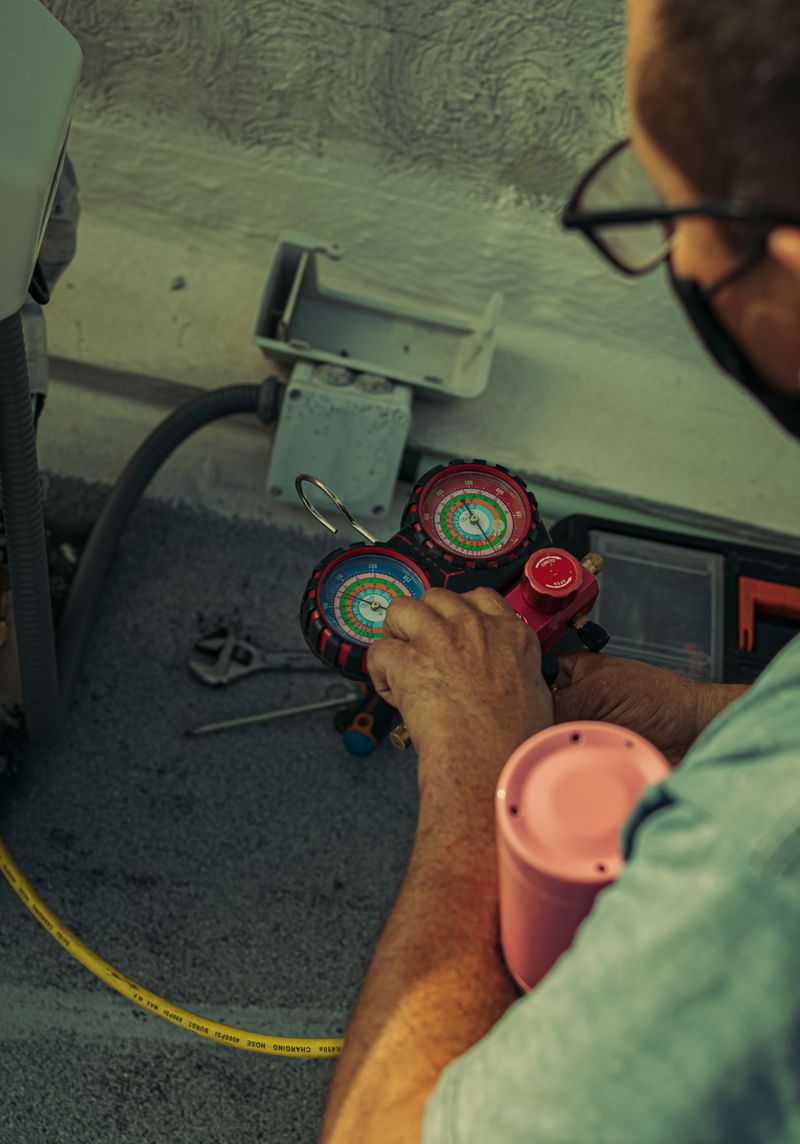
There is no universal best HVAC manifold gauge set. Choose one by the refrigerants and equipment you actually service, its maximum rated pressure, hose and fitting compatibility, port layout, temperature inputs, evacuation workflow, documentation needs, and current manufacturer support.
How this comparison was made
This guide compares current manufacturer specifications checked September 8, 2026. It does not claim hands-on testing, user consensus, or a performance ranking. Prices and retailer bundles are excluded because they change quickly; confirm the exact model and kit contents with the manufacturer and seller before ordering.
We reviewed current product pages and manuals for refrigerant coverage, pressure limits, connections, port layout, measurement inputs, connected functions, service parts, and A2L statements. Equipment labels and current manuals still control the job.
Manifold gauge decision matrix
| Job or workflow | Practical direction | Current examples to investigate | Verify before purchase |
|---|---|---|---|
| Apprentice or training bench | Analog gauges make pressure-temperature relationships visible and avoid app dependence | Yellow Jacket Series 41 models selected for the training refrigerants | Exact dial refrigerants, scale, working pressure, hoses, fittings, rebuild parts, and instructor requirements |
| Daily residential A2L service | Current analog or digital set explicitly documented for the equipment and refrigerant | Fieldpiece SM382V; Testo 550s; Yellow Jacket 42035/42036 | R-32/R-454B support, service-port adapters, hose ratings, temperature probes, and OEM A2L instructions |
| Mixed legacy and A2L equipment | Digital library can reduce the need to carry several refrigerant-specific analog sets | Fieldpiece SM382V or SM482V; Testo 550s or 557s | Every refrigerant in the current library, update method, pressure range, fittings, and cross-contamination procedure |
| Evacuation-heavy 4-port workflow | Separate vacuum connection can simplify hose routing and isolation | Fieldpiece SM482V; Testo 557s | Actual connection sizes, valve layout, vacuum-probe location, core tools, and evacuation-hose plan |
| Wireless probes and job logging | Compare the complete ecosystem, not the manifold alone | Fieldpiece SM382V/SM482V; Testo 550s/557s | Included versus optional probes, phone and app requirements, firmware path, export format, and offline behavior |
| Commercial refrigeration | Start with the full refrigerant list and pressure envelope | Current digital manifold or refrigerant-specific analog set | Exact refrigerants, blends and saturation references, maximum pressure, serviceability, documentation, and site procedures |
The examples are shortlist directions, not winners. A model can fit one workflow and be needlessly complex—or technically unsuitable—for another.
Current digital manifold options
Fieldpiece SM382V and SM482V
Fieldpiece’s current digital-manifold line lists the SM382V 3-port and SM482V 4-port, replacing the stale SMAN460 lead used in the earlier version of this guide. Fieldpiece states that both support more than 70 refrigerants, are A2L compatible, integrate with Job Link wireless tools, log data, and have a maximum manifold pressure of 870 psig.
The SM482V adds a 3/8-inch vacuum port to its three 1/4-inch connections; the SM382V uses three 1/4-inch connections. Plan probe placement and isolation with the vacuum pump and micron-gauge workflow rather than assuming an integrated manifold reading replaces every standalone micron-gauge setup.
Testo 550s and 557s
Testo identifies the 550s as a 2-way valve-block manifold and the 557s as a 4-way model. Its comparison lists 90 stored refrigerants, automatic refrigerant updates through the Testo Smart App, A2L suitability, IP54 protection, wireless probe support, and 0.5% full-scale pressure accuracy—not the unsupported 0.1% figure previously published here.
Kit contents vary. Confirm the full order number, batteries, probes, hoses, connection sizes, calibration certificate, and any app or phone dependency.
Current analog manifold options
Analog can be a strong training, backup, or refrigerant-specific choice when the dials, pressure rating, hoses, and fittings match the work. Use correct pressure-temperature data to interpret superheat and subcooling; neither value is a universal charging target.
Yellow Jacket’s Series 41 42035 is an A2L manifold-only model marked for R-32, R-454B, and R-410A; 42036 is the related set with three 60-inch 1/4-inch hoses. The separate 42045/42046 heat-pump manifold family uses high- and low-side gauges that the manufacturer rates to 800 psi. These are distinct analog products, not a “TITAN4 digital” model.
Do not buy by family name alone. Yellow Jacket lists many Series 41 variants with different refrigerants, scales, connections, and hose packages, so the complete part number is essential.
Digital vs. analog manifold gauges
| Factor | Analog | Digital |
|---|---|---|
| Refrigerant display | Printed dial scales; model-specific | Selectable library; verify coverage and update status |
| Superheat/subcooling | Separate temperatures and manual calculation | Calculated when correct pressure, refrigerant, and temperature inputs are supplied |
| Power | No batteries for the gauges | Batteries required; some functions may also depend on an app |
| Documentation | Usually recorded separately | Model-dependent logging, app, or export functions |
| Serviceability | Often rebuildable; verify parts | Verify sensors, valve kits, firmware, calibration, and repair support |
| Best fit | Training, backup, or known refrigerant set | Mixed refrigerants, commissioning, logging, or connected-probe workflows |
A calculated value is only as trustworthy as its refrigerant selection, probe contact, load, and airflow inputs.
A2L compatibility is an exact-model check
Do not assume every new system uses an A2L refrigerant. EPA’s May 2026 rule allows qualifying residential and light-commercial R-410A equipment manufactured or imported before January 1, 2025, to be installed until inventory is exhausted.
For R-32 or R-454B work, follow the exact equipment and tool manuals. Confirm the manifold, hoses, seals, fittings, recovery equipment, vacuum equipment, leak detector, cylinders, and work-area controls as a complete system. Start with the A2L refrigerant service safety checklist and compare the R-32, R-410A, and R-454B transition before standardizing a truck.
What a manifold does—and does not do
A manifold supports pressure measurement and controlled service connections. It is not a substitute for:
- A recovery machine: Robinair documents the RG6 as a refrigerant recovery machine, not a digital manifold.
- A vacuum pump: the pump removes air, moisture vapor, and other non-condensables during evacuation.
- A micron gauge: placement away from the pump helps evaluate system vacuum and decay.
- A leak detector: pressure or vacuum change can show that a system may leak but does not locate the leak.
- Wireless pressure probes: these can support a hoseless measurement workflow but are not a valve manifold.
Build the complete service kit from the actual workflow. The essential HVAC technician tools guide helps separate the manifold from the other instruments needed for recovery, evacuation, leak finding, electrical diagnosis, and commissioning.
Manifold gauge purchase-verification checklist
Before paying for a set, document:
- Exact model and kit number: Match the manufacturer page, manual, seller listing, and box label.
- Current refrigerant list: Verify every refrigerant you service, including blend and dew/bubble handling.
- Maximum working pressure: Check the manifold, gauges or sensors, hoses, valves, and adapters—not just one component.
- Hoses and fittings: Confirm connection size, length, working pressure, seals, low-loss or ball-valve ends, and tank or service-port adapters.
- Port and valve layout: Map pressure measurement, charging or recovery, and vacuum connections to your procedure.
- Temperature inputs: Identify included clamps, accuracy specifications, attachment method, and replacement options.
- Vacuum workflow: Decide where the micron measurement will occur and how the pump will be isolated for a decay test.
- Replacement parts and calibration: Check valve kits, seals, hoses, probes, batteries, repair channels, and calibration support.
- Firmware and app dependency: Verify supported devices, update method, offline operation, data export, and account requirements.
- Warranty and seller status: Read current written terms and confirm an authorized sales channel.
- Certification and safety boundary: Confirm Section 608 status, A2L training, employer procedures, adopted code, and current OEM instructions.
Section 608 boundary
This article is a purchasing guide for trained HVAC personnel, not a DIY refrigerant-service tutorial. EPA says attaching or detaching hoses and gauges, adding or removing refrigerant, and similar activities that may open the refrigerant circuit require the appropriate Section 608 technician certification. Registered apprentices must meet the applicable supervision requirements.
Homeowners can record symptoms, equipment model numbers, and service history, but should leave refrigerant-circuit work to qualified personnel. Certification also does not replace equipment-specific A2L competence, current manuals, employer safety procedures, or local code.
Bottom line
Verify the complete pressure, refrigerant, connection, probe, evacuation, documentation, and support chain. Analog can fit training or backup work; digital can fit connected workflows. Neither is universally best.
Next action: take your shortlist through the A2L service safety checklist before buying hoses, adapters, recovery equipment, or probes. One incompatible component can invalidate the workflow.
Sources and image credit
- Fieldpiece digital manifolds
- Fieldpiece SM382V specifications
- Fieldpiece SM482V specifications
- Testo digital manifold comparison
- Yellow Jacket Series 41 manifolds
- Yellow Jacket heat-pump manifolds
- Robinair RG6 recovery-machine manual
- EPA Section 608 technician certification
- EPA Section 608 questions for certified technicians
- EPA May 2026 Technology Transitions fact sheet
- AHRI Safe Refrigerant Transition Task Force resources
- Image: Pexels photo 6471912

ThermalTechPro Team
Independent trade-focused editorial team