Furnace pressure switch stuck open: what the code means
Quick answer
A furnace pressure switch stuck open code means the control did not see the pressure-switch circuit close when the ignition sequence required it. It does not prove that the switch failed. A nonrunning or weak inducer, obstructed intake or exhaust, condensate backup, damaged sensing tubing, wiring, installation conditions, or the switch itself can produce the same result. Record the exact model, code, sequence, and visible conditions, then have a qualified HVAC technician test the draft and safety circuit against the exact furnace manual.
Common questions
- Does a furnace pressure switch stuck open code mean the switch is bad?
- No. The code reports that the control did not see the expected circuit state. Restricted venting or intake, an inducer problem, condensate backup, sensing-tube damage, wiring, installation conditions, or a failed switch can all be involved.
- Can I bypass a furnace pressure switch temporarily?
- No. Never jumper or bypass a pressure switch. It is part of the combustion-air and venting safety sequence. Bypassing it can allow ignition without the condition the furnace is designed to prove.
- What is the difference between pressure switch open and stuck closed?
- An open-when-expected-closed fault occurs when the control starts the inducer but does not receive the required closure. A stuck-closed-at-start fault occurs when the circuit is already closed before inducer operation. The exact wording and code must be confirmed in the manual for that furnace.
- What should I tell the HVAC technician?
- Provide the complete furnace model, exact code wording or flash pattern, whether the inducer started, whether ignition began, outside weather, visible vent or drain conditions, recent work, and whether the fault repeats. Do not remove tubing or access panels to collect this information.
Source note: Reviewed October 2026 against current Goodman/Amana/Daikin model-family service literature, Daikin DM96VC/DC96VC installation instructions, Daikin service warnings, Carrier homeowner troubleshooting, and ENERGY STAR maintenance guidance. Fault codes, switch arrangements, draft requirements, venting, condensate routing, and test procedures are model-specific; use the current manual for the complete model number on the installed furnace.
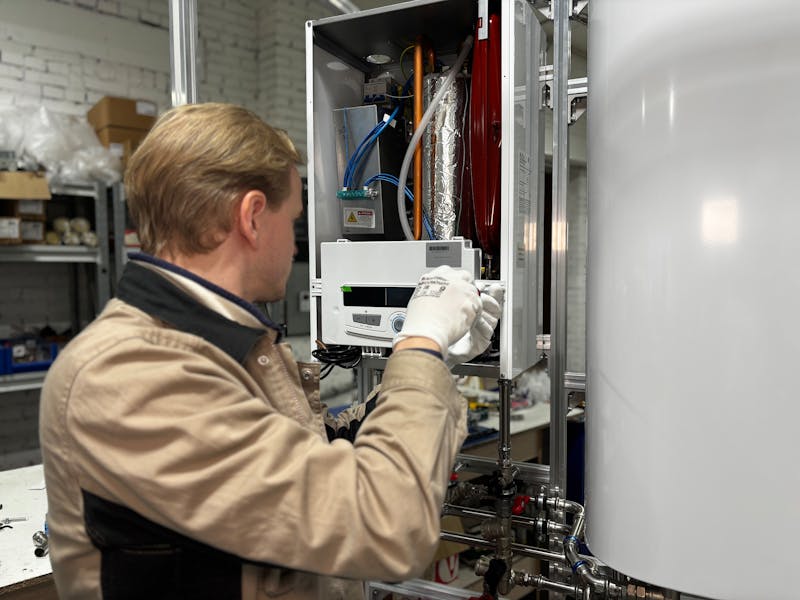
A furnace pressure switch stuck open code does not prove that the pressure switch is defective. It means the control board did not see the pressure-switch circuit close at the point when the furnace’s programmed ignition sequence expected it to close.
The cause may be elsewhere in the draft-proving path: the inducer, intake, exhaust vent, condensate system, sensing tubing, wiring, installation, or control. Use the exact model manual to decode the alert, observe one attempt without opening the cabinet, and give the evidence to a qualified HVAC technician.
Do not jumper the switch, blow or suck on its tubing, repeatedly reset the furnace, open the flue, or attempt live-voltage, manometer, gas, or combustion testing. Those actions can defeat a safety or hide the condition that caused the shutdown.
What the pressure-switch code means in the ignition sequence
The Goodman/Amana/Daikin service manual for covered GR9S, AR9S, and DR-series furnaces shows the sequence clearly:
- The thermostat calls for heat.
- The control checks its safety circuits.
- The induced-draft blower starts.
- Adequate draft changes the pressure-switch circuit to the expected state.
- Only then does the control proceed to ignition and gas-valve operation.
For the models in that manual, E2 means the pressure-switch circuit did not close when required, while E1 means it was closed at the start of the heating cycle when it should have been open. Other manufacturers and control boards use different codes and wording.
Find the complete model number in your records or on an owner-accessible label, then use the manufacturer’s current literature library. A generic “three flashes” chart cannot safely identify a code without the exact model and control.
Open when expected closed vs. stuck closed at startup
These two alerts point to different moments in the sequence.
| Manual’s fault description | When the unexpected state appears | What it establishes | What it does not establish |
|---|---|---|---|
| Pressure switch open, failed to close, or stuck open | After the inducer should create the required draft | The board did not receive the required circuit closure | That the switch itself is bad |
| Pressure switch closed or stuck closed | Before the inducer has established draft | The board sees a closed circuit too early | Whether the cause is the switch, wiring, trapped pressure, or another model-specific condition |
If the burners light and then shut off shortly afterward, follow the furnace flame-sensor symptom guide instead. If the main complaint is cool air, first classify the timing with the furnace blowing-cold-air guide. This page owns the earlier pressure-switch proof and code.
Answer-first pressure-switch diagnostic map
Observe no more than one normal call for heat from outside the closed cabinet. Stop after a repeated failure or lockout.
| What you can safely observe | Possible branch for a technician to investigate | Homeowner action |
|---|---|---|
| The inducer does not appear to start | Power, control input, door interlock, wiring, control, or inducer operation may have stopped the sequence | Record what did and did not run; do not open a panel or assume the switch caused it |
| The inducer starts, but ignition never begins | Draft may be insufficient, the pressure signal may not reach the switch, or the circuit may not change state | Record the code, sound, and timing; arrange service |
| A safe, ground-level view shows snow, ice, leaves, nesting material, or another obstruction at an exterior termination | Intake or exhaust restriction may be preventing adequate draft | Turn the furnace off and call for service; do not climb, insert tools, or disassemble venting |
| There is water near the furnace, drain overflow, unusual gurgling, or a symptom that follows freezing weather | A condensate or drain problem may affect a condensing furnace’s draft-proving path | Stop operation and report where and when water appeared; do not detach or reroute drains |
| Sensing tubing is visibly loose, kinked, cracked, soft, or water-filled without removing a panel or touching it | The pressure signal may not be reaching the switch correctly | Photograph only from a safe location and leave it undisturbed for the technician |
| The fault is intermittent or appears during wind, snow, ice, or after recent vent work | Termination, vent design, drainage, installation, or changing inducer performance may be involved | Note weather, wind direction if known, and recent work; do not keep resetting the furnace |
| The same code returns after a reset or the furnace enters lockout | The underlying condition remains or is recurring | Leave the system off and schedule qualified diagnosis |
The official flow for the covered Goodman/Amana/Daikin models checks inducer operation, sensing hose condition, intake and flue blockage, vent length and fittings, draft performance, and the drain system on condensing equipment before treating switch replacement as the answer. That ordering is the main takeaway, not a universal repair recipe.
Safe homeowner observation sheet
Capture these details before the service visit:
- Exact equipment: brand, complete model, and serial number from paperwork or a safely visible label
- Exact alert: code text, display characters, or flash pattern, plus where it appeared
- Sequence: thermostat call, inducer sound, ignition activity, blower activity, shutdown, retries, and lockout
- Timing: first occurrence, frequency, time into the heat call, and whether power was recently interrupted
- Conditions: outdoor temperature, snow, ice, wind, recent storms, and whether the symptom is weather-dependent
- Exterior terminations: only what is visible from safe ground level; include a photo if practical
- Water evidence: puddles, overflow, staining, gurgling, or ice near an owner-visible drain or termination
- Visible tubing: condition seen without panel removal or alteration; otherwise write “not safely visible”
- Recent changes: furnace, thermostat, roof, vent, drain, remodel, or maintenance work
- Safety evidence: gas odor, CO alarm, smoke, soot, flame outside the normal burner area, or abnormal venting
Use the HVAC maintenance log to keep the sequence with service findings. Carrier’s homeowner furnace troubleshooting guide limits owners to basic thermostat, power, filter, vent, and warning-sign checks and directs internal gas, electrical, and furnace work to qualified professionals.
When to shut down and leave
If you smell gas, do not operate electrical switches or try to relight the furnace. Leave the building and call the gas utility or emergency services from outside.
For a carbon-monoxide alarm, suspected exposure, soot, flame rollout, smoke, or abnormal venting, get everyone outside and follow the carbon-monoxide and HVAC emergency guidance. Do not use the pressure-switch code as reassurance that the furnace is safe.
An unexplained burning odor belongs in the furnace burning-smell triage guide, not a pressure-switch repair attempt.
What a useful technician report should confirm
This is a handoff standard, not a homeowner test procedure. Ask the technician to document:
- The exact model literature and control-board code definition used
- Where the ignition sequence stopped and whether the inducer operated as commanded
- Intake, exhaust, termination, condensate, drain, tubing, port, wiring, and installation findings
- Measured draft compared with the exact model and switch requirements
- Why the switch was or was not condemned after the draft path was evaluated
- The corrective action and a complete verified heat cycle after repair
- Required combustion, venting, gas, and safety checks before return to service
The Daikin DM96VC/DC96VC installation manual is an example of exact model-family literature with specific venting, drainage, and switch arrangements. It explicitly says not to bypass safety devices. Daikin’s separate service instructions and high-voltage warnings also reserve service for trained HVAC technicians. Neither document should be generalized to a different furnace.
Does pressure-switch replacement cost matter yet?
A part-only price is not a diagnosis. The service scope may involve venting, drainage, the inducer, wiring, installation correction, or a verified switch failure. Ask for a written quote that identifies the root cause, covered part number, labor, related corrections, post-repair verification, and warranty.
For prevention, ENERGY STAR’s HVAC maintenance checklist recommends annual pre-season service that checks the starting cycle, controls, electrical connections, condensate drainage, gas connections, combustion, and heat exchanger. Use the HVAC maintenance checklist to plan routine work, but do not treat maintenance as a reset for an active safety fault.
Sources and further reading
- Goodman/Amana/Daikin: 80% single-stage gas furnace service and troubleshooting manual
- Daikin: DM96VC/DC96VC installation instructions
- Daikin: service instructions and electrical safety warnings
- Carrier: homeowner furnace troubleshooting guide
- ENERGY STAR: heating and cooling maintenance checklist
Your next step
Write down the exact model and code, observe one call without opening the cabinet, and note the inducer, visible exterior terminations, water evidence, weather, and lockout timing. Then send that observation sheet to a qualified HVAC technician and ask for a model-specific diagnosis before authorizing a pressure-switch replacement.
Continue the no-heat diagnostic path safely
Use these resources to classify the symptom, protect occupants, document the fault, and keep cabinet-open work with a qualified technician.
- Furnace blowing cold air
Classify when cool air appears before narrowing a no-heat complaint to the ignition sequence.
- Furnace flame-sensor symptoms
Follow the later diagnostic branch when burners light and then shut off.
- Carbon monoxide and HVAC safety
Review alarm, symptom, evacuation, and emergency-response boundaries.
- HVAC maintenance log
Record the exact fault code, sequence, weather, visible conditions, and service findings.

ThermalTechPro Team
Independent trade-focused editorial team