Home AC refrigerant leak repair cost: Quote guide
Quick answer
A defensible home AC refrigerant leak repair cost is the sum of diagnosis, leak location and access, the component repair, refrigerant recovery and circuit preparation, the specified refrigerant quantity, code or permit work, and final verification. Published national ranges mix very different scopes, so compare written line items and exclusions rather than relying on one average.
Common questions
- How much does it cost to fix an AC refrigerant leak in a house?
- There is no dependable price until the leak source, component, access, refrigerant type, remaining charge, and warranty coverage are known. Ask for a written total that separates diagnosis, repair, refrigerant-circuit work, refrigerant quantity, verification, and exclusions.
- Can an AC refrigerant leak be repaired?
- Many leaks can be repaired, but the solution depends on the source. An accessible line or service connection may be repairable, while a leaking evaporator or condenser coil may require component replacement. The completed work should include leak verification and an operating check.
- Is adding refrigerant the same as repairing the leak?
- No. Adding refrigerant restores charge but does not close the leak. If a previously correct sealed system is low, ask where the refrigerant escaped, how the source was confirmed, and what repair and verification are included.
- When should I replace an AC instead of repairing a refrigerant leak?
- Compare replacement when the leak requires an expensive out-of-warranty component, the system has repeated leaks or other major risks, legacy refrigerant complicates service, or the complete repair is hard to justify against a properly sized replacement with a new warranty.
Source note: Price evidence was checked August 19, 2026 against public U.S. cost guides from Angi and HomeGuide. Safety and compliance guidance was reviewed against current EPA Section 608 certification and refrigerant-management pages. Local labor, equipment, access, refrigerant, warranty, code, and permit conditions determine the actual quote.
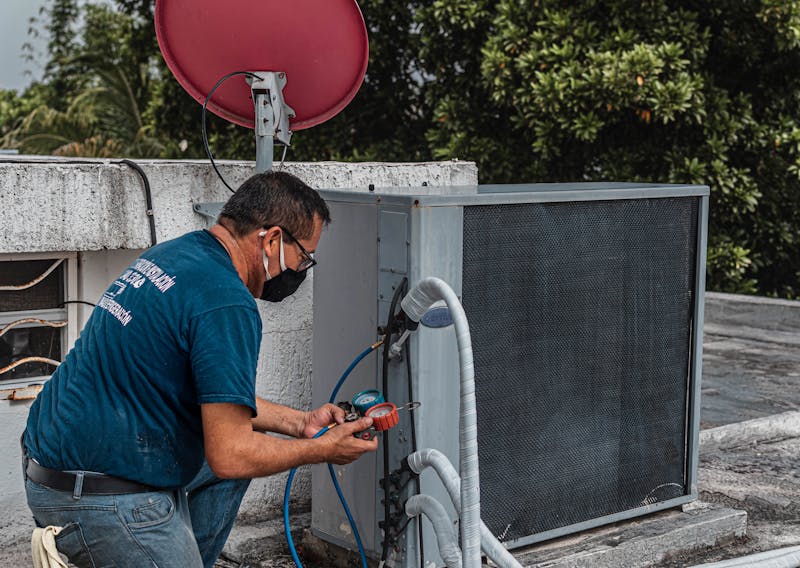
A quote to “fix an AC leak” may mean only adding refrigerant, or it may include hours of diagnosis, difficult attic access, a new coil, recovery, evacuation, a complete charge, and proof that the repaired system works. Those are not the same job, so their totals should not be compared as if they were.
The direct answer: home AC refrigerant leak repair cost should be built from the actual scope—diagnosis + access + component repair + refrigerant-circuit work + refrigerant + code items + verification. Do not approve a large repair from one bundled number unless the contractor identifies the leak, states what is included, and explains the conditions that could change the price.
If you are still deciding whether low charge is the problem, start with our AC refrigerant leak symptoms guide. Poor airflow, icing, and control faults can resemble a refrigerant problem and should be separated before pricing leak work.
What current price ranges do—and do not—tell you
This article’s price check was completed August 19, 2026. At that point, Angi published a $250–$1,600 overall range in its AC refrigerant leak repair cost guide, while HomeGuide published $200–$1,500 for finding and fixing a leak and refilling refrigerant in its AC leak repair guide.
Treat those figures as broad market context, not a quote for your house. Each publisher uses its own data, assumptions, and category boundaries. A minor accessible connection, an out-of-warranty evaporator coil, and a concealed line-set leak can all land under the same search phrase even though the labor, parts, and refrigerant work are completely different.
The more useful question is: What exact scope produced this total?
The AC leak repair cost framework
Ask the contractor to show these line items or state clearly which ones are bundled. A flat-rate proposal can still be transparent if it defines the included work, limits, and adders.
| Quote line | What it should explain | Why the price moves |
|---|---|---|
| Diagnosis or service call | What was tested and whether this fee is credited to approved work | Dispatch, test time, system complexity, and after-hours service |
| Leak location | Confirmed location, method, and any limit on search time or return visits | Intermittent, very small, concealed, or multiple leaks take more time to isolate |
| Access | Panels, attic or crawlspace work, line-cover removal, or building restoration | Heat, clearance, height, and finished surfaces change labor and trade coordination |
| Component repair | The exact joint, valve, line section, coil, or other part and its part/labor warranty | A repairable connection is a different scope from coil or line-set replacement |
| Recovery and circuit work | Recovery if required, pressure or leak verification, evacuation, and other OEM-required steps | Remaining charge, contamination risk, opened volume, and manufacturer procedure vary |
| Refrigerant | Refrigerant designation, estimated quantity, pricing basis, and treatment of recovered material | Type, required amount, system capacity, line length, supply, and company pricing differ |
| Code, permit, and supporting work | Permit, electrical, drain, platform, detection, ventilation, or other local requirements | Jurisdiction, equipment type, and replacement scope determine what applies |
| Startup and verification | How the repair and final operation will be checked and documented | A valid check needs suitable operating conditions and model-specific targets |
| Warranty, tax, and exclusions | Covered part, uncovered labor or refrigerant, tax, return-trip terms, and conditional adders | Manufacturer, labor, and home-warranty coverage are not interchangeable |
This framework prevents two common comparison errors. First, a low bid may exclude refrigerant, access, or return-trip labor. Second, a high bid may already include a warranted coil, full circuit procedure, and a stated maximum refrigerant quantity.
Why leak location changes the repair
An accessible service connection or exposed tubing may allow a localized repair. A leak within an evaporator or condenser coil often leads to component replacement rather than a field repair, depending on the construction, location, manufacturer guidance, and warranty. A concealed line set may require isolation testing and separate building work before the HVAC scope is even known.
Ask for the specific leak location, not simply “low refrigerant.” EPA guidance distinguishes tests that can locate a leak from readings that only suggest the appliance is leaking. Its Section 608 technician Q&A lists location-capable methods such as electronic detectors, bubble tests, ultrasonic tests, and gas-imaging cameras.
Technicians choosing an instrument can compare sensor types and refrigerant compatibility in our HVAC refrigerant leak detector guide. Homeowners should use the confirmed result to understand the quote, not attempt to open or test the refrigerant circuit themselves.
Why refrigerant is not just a per-pound purchase
The equipment nameplate identifies the refrigerant; it is not a menu of interchangeable products. R-22, R-410A, R-32, and R-454B involve different equipment designs, service procedures, availability, and safety considerations. Our R-32 vs. R-410A vs. R-454B guide explains the distinctions, while the R-22 phaseout guide covers the legacy-system context.
A useful quote states the refrigerant type and the pricing basis. It should also state whether the estimated quantity is a capped allowance, a per-pound charge, or part of a flat rate. The nameplate charge alone may not equal the amount needed: the system may retain some charge, and an installation may have a field-adjusted charge for line length or matched equipment.
Do not compare an online wholesale cylinder price with an installed service price. The contractor’s scope can include certified labor, recovery equipment, tools, transportation, inventory, and final charging work—not just the material in the cylinder.
What a complete repair should prove
The proposal should describe the path from confirmed leak to verified operation without turning the homeowner into the technician. Depending on the repair and OEM procedure, that path may include recovering refrigerant, opening and repairing the circuit, replacing a filter-drier or other specified item, pressure-testing the repair, evacuating the opened system, charging it correctly, and checking performance under valid conditions.
Charging cannot be judged from pressure alone. Airflow, load, equipment staging, metering device, line temperatures, and manufacturer targets matter; our superheat versus subcooling guide explains that diagnostic context.
Ask what result will appear on the invoice: confirmed repair location, test or verification method, refrigerant type and quantity, and final operating evidence. Also ask what happens if the same location leaks during the stated labor-warranty period.
Repair or replace? Compare complete scopes
Repair is usually easier to justify when the leak is confirmed and accessible, the rest of the matched system is reliable, the part is available or under warranty, and the complete repair preserves useful service life. Replacement deserves a side-by-side proposal when a major coil or line-set job is out of warranty, leaks have repeated, other costly components are deteriorating, or legacy refrigerant and part availability add risk.
Avoid a universal age or percentage rule. Instead, compare these two written totals:
Net repair decision = complete repair price − confirmed warranty credits + the value you assign to near-term failure risk.
Net replacement decision = complete installed-system price − confirmed incentives + required duct, electrical, permit, and code work.
The replacement proposal should identify matched model numbers, sizing basis, efficiency, controls, commissioning, and warranties. Use the HVAC installation cost guide for scope context and the replacement quote comparison worksheet to line up bids without hiding exclusions.
Questions to ask before authorizing the work
- Where is the leak, and what evidence confirmed that location?
- Does the price include diagnosis, access, the component, recovery, verification, evacuation, refrigerant, and startup?
- What refrigerant and estimated quantity are included, and how are overruns priced?
- Is the part covered by the manufacturer, and which labor, refrigerant, shipping, or processing costs remain? Review our HVAC warranty guide before assuming “under warranty” means no charge.
- What could change the price after authorization? Ask for written unit prices, allowances, or a not-to-exceed total where practical.
- How will the contractor document that the leak is repaired and the system is operating correctly?
For a large repair, compare at least two proposals with the same scope. If one contractor has not located the leak and another has, you do not yet have comparable bids.
Safety and compliance boundary
Homeowners can record symptoms, clear safe access, photograph model and serial plates, and gather invoices and warranty documents. Do not connect gauges, add refrigerant, break a sealed connection, or open electrical compartments.
EPA Section 608 certification requirements apply to technicians whose work can release refrigerant, including attaching gauges and adding or removing refrigerant. EPA also prohibits intentional venting of covered refrigerants and substitutes during service, repair, and disposal. State or local contractor licensing, permits, codes, and manufacturer instructions can add requirements.
Your next step
Before the appointment, write down when cooling changed, whether ice appeared, recent filter or service history, and any prior refrigerant additions. Photograph the equipment labels and find the warranty registration. The HVAC maintenance log gives you one place to organize that evidence.
Then request a written quote using the line-item framework above. If the repair involves a major component or uncertain future risk, request a complete replacement proposal at the same time. The best decision comes from two defined scopes—not from one seductive national average.
Move from leak evidence to a defensible HVAC decision
Use these related guides to verify the symptom path, understand the refrigerant, and compare repair with replacement.
- AC refrigerant leak symptoms
Separate likely charge loss from airflow and control problems before pricing a leak repair.
- R-32 vs. R-410A vs. R-454B
Understand why refrigerant type changes compatibility, safety procedures, and service context.
- HVAC warranty guide
Check which part, labor, refrigerant, shipping, and registration terms affect the net repair price.
- HVAC replacement quote worksheet
Compare a major repair with a complete, properly scoped replacement proposal.

ThermalTechPro Team
Independent trade-focused editorial team