HVAC maintenance agreement cost and scope worksheet
Quick answer
Compare HVAC maintenance agreements by matching the same equipment and named tasks, then add the quoted plan price to every expected excluded fee. A useful agreement states who performs the work, when visits occur, what materials and measurements are included, how priority service works, and how cancellation or renewal is handled.
Common questions
- How much should an HVAC maintenance agreement cost?
- There is no reliable national price that applies to every property. Compare actual written quotes for the same equipment, visit schedule, task list, included materials, fees, term, and exclusions, then calculate the full annual obligation shown in each proposal.
- Is an HVAC maintenance agreement the same as a warranty?
- No. A maintenance agreement pays for defined inspection or maintenance services. A warranty is a promise associated with a product, while an optional service contract is purchased separately. One document may coordinate with another, but the coverage should not be treated as interchangeable.
- What should an HVAC maintenance agreement include?
- It should identify the covered equipment, responsible provider, visit timing, named tasks, included materials and measurements, repair and emergency terms, exclusions, documentation, price, renewal, cancellation, transfer, and dispute process.
- Does a maintenance plan prevent every HVAC failure?
- No. Maintenance can identify conditions and address defined tasks, but it cannot guarantee that equipment will not fail. Ask what the provider will inspect, measure, document, correct, or quote instead of relying on a general promise of fewer breakdowns.
Source note: Reviewed August 2026 against ANSI/ACCA 4 QM – 2019 (R2024), ACCA's quality-standards overview, ENERGY STAR's HVAC maintenance checklist, FTC warranty guidance, and the DOE/FEMP O&M guide. The signed agreement, current equipment instructions, warranty terms, adopted code, and applicable state law control.
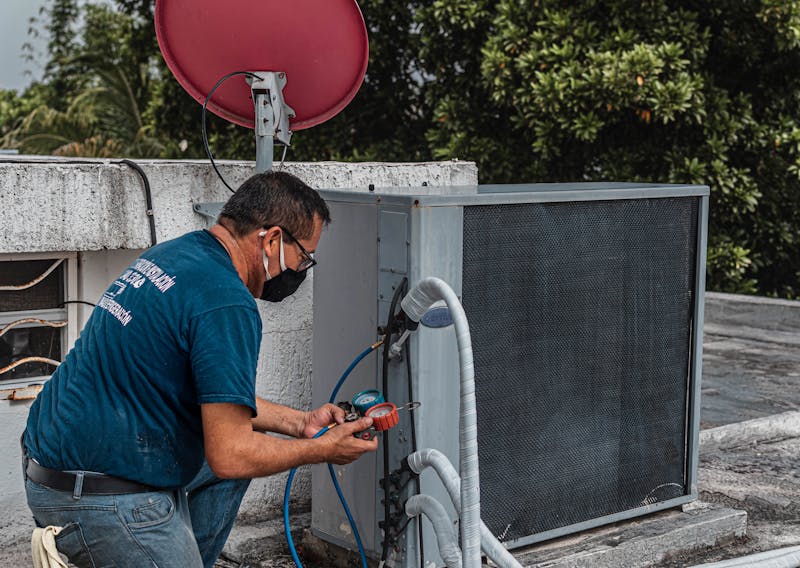
Two HVAC maintenance agreements can carry similar prices and cover very different work. One may include documented electrical, airflow, drain, and combustion checks; another may be a visual inspection with most cleaning, materials, and repairs billed separately.
The fair comparison is not plan price versus plan price. Compare the same equipment and scope, the complete quoted obligation, and the written terms side by side.
First identify what each document is
These terms do different jobs:
- A maintenance agreement defines scheduled inspection and maintenance services.
- A manufacturer or contractor warranty states what the warrantor promises to remedy under its terms.
- A separately purchased service contract provides optional product service for an additional fee.
The FTC distinguishes a separately purchased service contract from a warranty included with a product and calls for clear disclosure of service-contract terms. Read our HVAC warranty explainer before treating maintenance, repair discounts, parts warranties, and labor obligations as interchangeable.
This worksheet is not legal advice. The signed agreement, current equipment instructions, warranty requirements, adopted code, and state law control.
Record the property and equipment first
Give every bidder the same inventory. A lower quote may otherwise omit a system, difficult access, or known condition.
| Comparison input | Your property record |
|---|---|
| Service address and property use | _____ |
| Equipment served | _____ |
| System type and fuel or refrigerant | _____ |
| Manufacturer, model, and serial number | _____ |
| Installation or estimated equipment age | _____ |
| Known condition, active faults, or prior repairs | _____ |
| Typical usage and occupied schedule | _____ |
| Access limits, attic/crawlspace work, roof access, or parking | _____ |
| Manufacturer, labor, or service-contract coverage still active | _____ |
| OEM maintenance or recordkeeping requirements supplied to bidders | _____ |
Ask each provider to separate pre-existing corrective work from recurring maintenance.
Side-by-side HVAC agreement worksheet
Copy the contract language or page reference into this table. A sales conversation is not a written commitment.
| Question | Quote A | Quote B | Quote C |
|---|---|---|---|
| Contracting company | _____ | _____ | _____ |
| Company actually performing service | _____ | _____ | _____ |
| Subcontracting allowed and disclosed | _____ | _____ | _____ |
| Covered equipment and locations | _____ | _____ | _____ |
| Contract start, end, and visit count | _____ | _____ | _____ |
| Seasonal visit timing | _____ | _____ | _____ |
| Scheduling window and rescheduling rule | _____ | _____ | _____ |
| Named inspection and maintenance tasks | _____ | _____ | _____ |
| Measurements and written records supplied | _____ | _____ | _____ |
| Filters, belts, drain treatment, lubricants, and other consumables included | _____ | _____ | _____ |
| Cleaning included versus separately quoted | _____ | _____ | _____ |
| Diagnostic, travel, permit, after-hours, and other fees | _____ | _____ | _____ |
| Labor, parts, refrigerant, and taxes | _____ | _____ | _____ |
| Emergency priority and response commitment | _____ | _____ | _____ |
| Repair authorization and spending limit | _____ | _____ | _____ |
| Repair discount and exclusions | _____ | _____ | _____ |
| Cancellation, refund, transfer, auto-renewal, contact, and dispute terms | _____ | _____ | _____ |
| Annual price and payment schedule | _____ | _____ | _____ |
Compare named tasks, not “tune-up” labels
ANSI/ACCA 4 QM – 2019 (R2024) establishes minimum inspection tasks for residential HVAC maintenance and gives contractors and customers a common comparison framework. ENERGY STAR’s maintenance checklist describes typical control, electrical, lubrication, condensate, coil, airflow, refrigerant, and combustion checks.
Do not rely on an “ACCA compliant” or “ENERGY STAR certified” label. Ask for the tasks, methods, acceptance criteria, corrective actions, and records for your equipment. ACCA retains copyright in its standard, so use the current official document rather than a copied checklist.
Cooling and heat-pump questions
- Are indoor and outdoor coils inspected, and what level of cleaning is included?
- Are condensate pan, drain, trap, pump, and overflow controls inspected or serviced?
- Are electrical connections, controls, contactors, capacitors, motors, and safeties checked with recorded results where appropriate?
- Is blower condition and system airflow evaluated? If static pressure is promised, ask where it is measured and what equipment data is used. Our static-pressure workflow explains why one universal limit is not defensible.
- Is refrigerant performance evaluated under valid operating conditions, and is leak diagnosis or refrigerant itself extra?
- For heat pumps, are heating, cooling, auxiliary heat, and defrost functions addressed when conditions permit?
Furnace or boiler questions
- Are ignition, burners, venting, safeties, and accessible heat-transfer surfaces inspected?
- Is combustion testing included for the equipment and fuel, and will results be documented?
- Are gas or oil connections and operating conditions checked within the technician’s authorized scope?
- Are pumps, valves, expansion components, drains, and water condition addressed for hydronic equipment?
Combustion, gas, high-voltage, and refrigerant work belongs to qualified personnel. Use the DIY-versus-professional repair guide and carbon monoxide safety guide to set safe boundaries.
Find every included material and excluded charge
The DOE/FEMP O&M guide distinguishes inspection-only, preventive-maintenance, labor, and fuller-coverage contracts. An “agreement” label alone does not reveal who carries each cost.
For each quote, mark included, excluded, allowance, or price not stated for:
- Replacement filters and belts
- Drain treatment and condensate-line clearing
- Coil, blower, burner, or heat-exchanger cleaning
- Lubricants, cleaners, fasteners, and minor consumables
- Diagnostic labor during and outside scheduled visits
- Repair labor, parts, refrigerant, and recovery
- Permits, travel, access equipment, shipping, and taxes
- Weeknight, weekend, holiday, or emergency service
Clarify whether “cleaning” means accessible cleaning or removal and deep cleaning. For a repair discount, identify the base price, covered labor or materials, exclusions, maximum discount, and combination rules. A percentage alone is not a calculable benefit.
Define priority and repair authority
Priority service must mean something in writing. Record the dispatch order or response window, covered hours, geographic limits, availability exclusions, and added fees. “Front of the line” is not a response commitment.
The agreement should also state:
- Who may approve a repair and how approval is documented
- The dollar limit, if any, for work without additional authorization
- Whether an unsuccessful diagnosis or declined repair creates a fee
- How pre-existing conditions, abuse, neglect, access problems, and excluded faults are handled
- Whether the provider can recommend replacement and whether a second opinion is permitted
Maintenance cannot prevent every failure. Require a defined process for findings, authorization, and documentation.
Calculate the annual quoted obligation
Use figures from the signed quotes and your expected use of excluded services:
Annual quoted obligation = plan price + taxes and mandatory fees + expected excluded visit charges + expected excluded labor and materials + other contract-required charges
List every reasonably expected exclusion with its quantity and quoted unit price. If a bidder will not state a charge, write not stated rather than zero.
This is not a return-on-investment forecast. Do not assume a discount, avoided repair, energy reduction, or payback.
Finish with a decision record
Record whether the provider can deliver the work.
| Decision factor | Evidence from selected quote |
|---|---|
| Scope matches the listed equipment and OEM needs | _____ |
| Provider and responsible service entity are identified | _____ |
| Technician capability and required credentials are confirmed | _____ |
| Tasks, materials, measurements, and deliverables are explicit | _____ |
| Exclusions and total quoted obligation are understood | _____ |
| Priority, authorization, and communication process are workable | _____ |
| Warranty coordination and recordkeeping are clear | _____ |
| Cancellation, renewal, transfer, refund, contact, and dispute terms are acceptable | _____ |
| Selection and reason | _____ |
| Reviewer, decision date, and agreement version | _____ |
Keep the signed proposal, inventory, visit reports, measurements, invoices, authorizations, and warranty correspondence together. If plan enrollment is tied to a new installation, add its required payments and exclusions to the HVAC installation cost worksheet. For replacement proposals, use the HVAC replacement quote-comparison tool.
Bottom line
The best HVAC maintenance agreement is the one whose written scope fits the equipment, whose provider can perform and document the work, and whose full annual obligation is clear. Compare the named tasks and exclusions first, then price.
Start with the site’s seasonal HVAC maintenance checklist to define the work your property needs. Return to this worksheet with the actual proposals, resolve every blank, and attach the final scope to the agreement before signing.
Sources and image credit

ThermalTechPro Editorial Team
Independent trade-focused editorial team